
Spinal Decompression Therapy: A Complete Guide to Pain Relief and Spinal Healing
Back pain is one of the most common health complaints worldwide, affecting millions of people every year. Whether caused by poor posture, injury, disc problems, or age-related degeneration, spinal discomfort can significantly impact daily life. One of the increasingly popular non-surgical approaches for managing spinal conditions is spinal decompression therapy.
This advanced therapeutic technique is designed to relieve pressure on the spine, promote natural healing of spinal discs, and reduce nerve-related pain. In this article, we’ll explore what spinal decompression therapy is, how it works, its benefits, conditions it treats, and what patients can expect during treatment.
What Is Spinal Decompression Therapy?
Spinal decompression therapy is a non-surgical, motorized traction-based treatment designed to gently stretch the spine. The goal is to relieve pressure from spinal discs and nerves while creating a healing environment within the spinal column.
The spine is made up of a series of vertebrae (bones) cushioned by soft discs that act as shock absorbers. When these discs become compressed, bulged, or herniated, they can press on nearby nerves, leading to pain, numbness, or weakness.
Spinal decompression works by carefully reducing this pressure and allowing the spine to return to a more natural alignment. According to clinical explanations, this process may help relieve pain associated with nerve compression and disc degeneration .
Conditions Treated with Spinal Decompression
Spinal decompression therapy is often recommended for individuals experiencing chronic back or neck pain related to disc and nerve problems. Common conditions include:
Bulging or Herniated Discs
When spinal discs protrude or rupture, they can press on nerves and cause pain, tingling, or numbness.
Sciatica
Compression of the sciatic nerve can lead to radiating pain from the lower back down to the legs,
Degenerative Disc Disease
Age-related wear and tear can reduce disc height and elasticity, leading to chronic pain.
Spinal Stenosis
A narrowing of the spinal canal that places pressure on nerves.
Pinched Nerves
Compression of spinal nerves can cause localized or radiating discomfort.
Spinal decompression therapy aims to relieve these issues by reducing mechanical pressure on affected spinal structures.
Benefits of Spinal Decompression Therapy
Many patients choose spinal decompression because it is non-invasive and drug-free. Some potential benefits include:
Pain Relief Without Surgery
One of the main advantages is that it may help relieve chronic pain without surgical intervention.
Improved Disc Health
By promoting circulation of fluids and nutrients, decompression may support disc hydration and healing.
Reduced Nerve Compression
Relieving pressure on spinal nerves can decrease symptoms like numbness, tingling, and radiating pain.
Better Mobility and Flexibility
As spinal pressure decreases, patients often experience improved movement and reduced stiffness.
Comfortable Treatment Experience
Most patients describe the therapy as gentle stretching rather than painful manipulation.
Overall, spinal decompression is often considered part of a conservative treatment approach before surgical options are explored.
How Does Spinal Decompression Therapy Work?
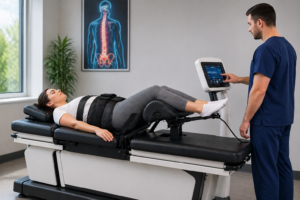
During spinal decompression therapy, the patient lies comfortably on a specialized decompression table. A harness is placed around the pelvis (for lower back treatment) or around the head (for neck treatment), depending on the area being treated.
The machine then applies a controlled stretching force to the spine in a gentle, rhythmic pattern. This creates a “traction effect” that helps:
- Reduce pressure on spinal discs
- Increase space between vertebrae
- Encourage movement of oxygen, water, and nutrients into spinal tissues
- Promote retraction of bulging or herniated disc material
One of the key theories behind this therapy is that it creates negative pressure inside the disc, which may help pull bulging disc material back into place and support healing .
Unlike manual traction, modern decompression machines allow for precise control of force and targeting specific spinal levels, making the therapy more customized and comfortable.
Surgical vs Non-Surgical Decompression
It’s important to understand that “spinal decompression” can refer to two different approaches:
Non-Surgical Decompression
- Uses traction-based machines
- No surgery or anesthesia
- Focuses on relieving pressure gradually
- Often used for chronic pain management
Surgical Decompression
- Involves removing part of a disc, bone, or tissue
- Used for severe nerve compression cases
- Includes procedures like discectomy or laminectomy
- Requires recovery time and medical supervision
Most patients begin with non-surgical methods before considering surgery.
What Happens During a Session?
A typical spinal decompression session lasts between 20 to 45 minutes.
Here’s what patients can expect:
- The patient lies on a motorized traction table
- A harness is secured around the targeted area
- The machine applies gentle stretching cycles
- The spine is intermittently relaxed and decompressed
- The session ends with gradual release of tension
Patients usually remain fully clothed and can return to normal activities immediately after treatment.
Many providers recommend a series of sessions over several weeks for best results.
Is Spinal Decompression Therapy Safe?
For most people, spinal decompression therapy is considered safe and non-invasive when performed by trained professionals. However, it is not suitable for everyone.
It may not be recommended for individuals with:
- Severe osteoporosis
- Spinal fractures
- Spinal implants or hardware
- Pregnancy
- Certain advanced spinal conditions
A proper medical evaluation is always necessary before starting treatment.
Who Is a Good Candidate?
Spinal decompression therapy may be suitable for individuals who:
- Have persistent back or neck pain
- Suffer from disc-related conditions
- Experience sciatica or nerve pain
- Have not improved with physical therapy or medications
- Want a non-surgical treatment option
A consultation with a spine specialist or chiropractor helps determine suitability.
What Results Can You Expect?
Results vary depending on the severity of the condition and overall health of the patient. Some individuals notice improvement within a few sessions, while others require longer treatment plans.
Potential outcomes include:
01.
Reduced pain intensity
02.
Improved spinal function
03.
Increased comfort during movement
04.
Decreased nerve-related symptoms
However, like all therapies, results are not guaranteed and depend on individual conditions.
Final Thoughts
Spinal decompression therapy is a promising non-surgical option for individuals struggling with chronic back or neck pain caused by disc compression or nerve irritation. By gently stretching the spine and reducing pressure on spinal structures, this therapy aims to support natural healing and improve quality of life.
While it is not a universal cure, many patients find it helpful as part of a broader treatment plan that may include physical therapy, posture correction, and lifestyle changes.
If you are experiencing ongoing spinal discomfort, consulting a qualified healthcare provider is the best step toward determining whether spinal decompression therapy is right for you.