
Advanced Spinal Decompression: Modern Non-Surgical Relief for Chronic Back Pain
Back and neck pain are among the most common health complaints worldwide, affecting people of all ages and lifestyles. Long hours of sitting, poor posture, injuries, and age-related spinal degeneration all contribute to conditions that can significantly impact daily life. For many individuals seeking relief without surgery or long-term medication use, chiropractic decompression therapy has emerged as a popular, non-invasive treatment option.
This therapy combines principles of chiropractic care with modern spinal decompression technology to reduce pressure on the spine, improve disc health, and support the body’s natural healing processes. In this article, we’ll explore what chiropractic decompression therapy is, how it works, the conditions it treats, its benefits, and what patients can expect during treatment.
What Is Advanced Spinal Decompression?
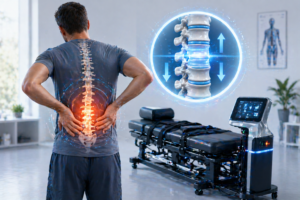
Advanced spinal decompression is a non-invasive, technology-driven therapy designed to relieve pressure on the spinal column. It works by gently stretching the spine using a computerized traction system that is programmed to target specific spinal levels with high precision.
The spine is composed of vertebrae separated by soft intervertebral discs. These discs act as shock absorbers, but they can become compressed, bulged, or herniated due to aging, injury, poor posture, or repetitive strain. When this occurs, nearby nerves may become irritated or compressed, leading to pain, numbness, or weakness.
Advanced spinal decompression aims to create negative pressure within the spinal discs, allowing bulging or herniated material to retract while encouraging nutrient flow and healing.
This therapy is considered an evolution of traditional traction because it is more precise, customizable, and comfortable for patients.
Conditions Treated with Advanced Spinal Decompression
Advanced spinal decompression is commonly used for a variety of spinal conditions, especially those involving disc degeneration and nerve compression.
Herniated Discs
A herniated disc occurs when the inner disc material pushes through its outer layer, irritating nearby nerves and causing pain or weakness.
Bulging Discs
Unlike a herniation, a bulging disc remains intact but protrudes outward, often compressing surrounding nerves.
Sciatica
Sciatica is one of the most common conditions treated with spinal decompression. It typically results from compression of the sciatic nerve in the lower back.
Degenerative Disc Disease
Over time, spinal discs lose hydration and elasticity, leading to reduced cushioning and chronic pain.
Spinal Stenosis
A narrowing of the spinal canal can place pressure on nerves, causing pain, numbness, or difficulty walking.
Facet Joint Syndrome
Inflammation or degeneration of spinal joints can contribute to localized back pain and stiffness.
Chronic Neck and Lower Back Pain
Many patients suffer from long-term pain due to posture issues, repetitive stress, or unresolved injuries.
Benefits of Advanced Spinal Decompression
Patients often choose advanced spinal decompression because it offers a non-surgical, drug-free alternative to traditional pain management approaches.
Non-Invasive Treatment Option
No incisions, anesthesia, or surgical recovery are required.
Reduced Nerve Compression
By increasing space between vertebrae, pressure on irritated nerves may be reduced.
Disc Rehydration and Healing Support
Improved circulation helps deliver oxygen and nutrients to damaged spinal discs.
Pain Relief Without Medication
Many patients reduce their reliance on painkillers over time.
Improved Mobility
As spinal pressure decreases, flexibility and range of motion often improve.
Targeted Therapy
Treatment can be customized to specific spinal levels and patient conditions.
Comfortable Experience
Most patients describe the therapy as a gentle stretching sensation rather than pain.
How Advanced Spinal Decompression Works
During treatment, the patient lies on a specialized motorized decompression table. A harness is placed around the lower body (for lumbar treatment) or upper body (for cervical treatment), depending on the area of concern.
What makes this therapy “advanced” is the use of computerized control systems that adjust the force and angle of spinal stretching in real time.
The treatment cycle typically includes:
- Gradual spinal stretching (decompression phase)
- Controlled relaxation (retraction phase)
- Repeated cycles tailored to the patient’s condition
This process helps create a vacuum-like effect inside the spinal discs, which may:
- Reduce pressure on compressed nerves
- Encourage retraction of bulging or herniated disc material
- Increase hydration and nutrient exchange within the disc
- Improve spinal alignment and mobility
By carefully controlling force and timing, advanced spinal decompression provides a more targeted and comfortable experience compared to traditional traction methods.
Is Advanced Spinal Decompression Safe?
Advanced spinal decompression is generally considered safe when performed by trained healthcare professionals. It is a conservative treatment with a low risk of complications.
However, it may not be appropriate for everyone. Individuals with the following conditions should be evaluated carefully:
- Severe osteoporosis
- Spinal fractures or trauma
- Advanced spinal instability
- Certain spinal implants or surgical hardware
- Pregnancy (case-dependent)
A thorough consultation and diagnostic review are necessary before starting treatment.
Advanced Spinal Decompression vs Traditional Methods
Understanding the difference between advanced and traditional decompression helps clarify why many clinics now prefer modern systems.
Traditional Traction
- Uses constant pulling force
- Limited customization
- Less precise targeting
- May cause discomfort in some patients
Advanced Spinal Decompression
- Uses computerized control systems
- Targets specific spinal segments
- Uses cyclical stretching and relaxation
- Improved comfort and precision
- Designed for disc-related conditions
Who Can Benefit Most?
Advanced spinal decompression may be ideal for individuals who:
- Suffer from chronic back or neck pain
- Have disc herniation or bulging discs
- Experience nerve-related symptoms such as radiating pain
- Want to avoid surgery or long-term medication use
- Have not responded well to physical therapy alone
It is often recommended as part of a comprehensive, conservative spinal care plan.
Expected Results and Recovery
Results vary depending on the severity of the condition, overall health, and consistency of treatment. Some patients notice improvement early in their care plan, while others require longer treatment periods.
Potential improvements include:
- Reduced pain intensity
- Decreased nerve irritation
- Improved spinal flexibility
- Better posture and mobility
- Enhanced daily function and comfort
Because healing is gradual, consistent attendance and supportive lifestyle changes often improve outcomes.
What Makes It “Advanced”?
Advanced spinal decompression differs from basic traction therapy in several important ways:
01.
Computer-Guided Precision
Instead of applying a constant pulling force, advanced systems use computerized algorithms to adjust tension dynamically based on patient needs.
02.
Targeted Spinal Levels
The therapy can focus on specific spinal segments affected by disc damage or nerve compression.
03.
Cyclic Decompression Patterns
Rather than a continuous stretch, the spine is gently decompressed and relaxed in cycles, improving effectiveness and comfort.
04.
Improved Patient Comfort
Patients often experience less discomfort because the system adapts to muscle resistance and spinal response.
05.
Enhanced Treatment Outcomes
The precision of the therapy allows for more consistent and predictable results in suitable patients.
What to Expect During Treatment
A typical advanced spinal decompression session is performed in a clinical setting and lasts about 20 to 45 minutes.
The process includes:
- Initial assessment and positioning
- Placement on a computerized decompression table
- Attachment of supportive harnesses
- Controlled spinal stretching cycles
- Relaxation intervals between decompression phases
- Completion and post-treatment guidance
Patients usually remain fully clothed and can return to normal activities immediately after treatment.
Most treatment plans involve multiple sessions per week over several weeks, depending on the severity of the condition.
Final Thoughts
Advanced spinal decompression represents a significant advancement in non-surgical spinal care. By combining computerized technology with gentle, targeted traction, it offers a modern approach to treating disc-related pain and nerve compression.
While it may not be suitable for every patient or condition, many individuals find it to be a valuable alternative to surgery or long-term medication use. When combined with chiropractic care, rehabilitation exercises, and lifestyle improvements, advanced spinal decompression can play an important role in restoring spinal health and improving quality of life.
If you are experiencing ongoing back or neck pain, consulting a qualified spine specialist can help determine whether advanced spinal decompression is appropriate for your condition.